Virtual Annual General Meeting: AGM webcasting for listed companies
At a glance (as of September 2026): MediaEvent Services broadcasts annual general meetings in audio and video. The broadcast is integrated with the share registrar’s AGM portal so that only accredited shareholders gain access. Video production including audio is available on request. Invitation management, accreditation and voting sit with the registrar — the registrars integrated include Computershare and ADEUS. MES has broadcast the Lufthansa Group’s AGM since 2011 and delivered the Group’s first fully virtual AGM in 2020. The general meetings of E.ON, thyssenkrupp and the freenet Group are broadcast on the same platform. In the 2026 AGM season, 21 of the 38 DAX companies returned to an in-person meeting. It is still broadcast.
What MediaEvent Services covers — and what the registrar covers
An annual general meeting is carried by two service providers, and the line between them is sharp. The share registrar is responsible for everything tied to the share register. MediaEvent Services is responsible for the broadcast and its integration with the registrar’s portal. Anyone looking for a single-source provider should know about this split: it is the reason both sides have to talk to each other rather than be contracted one after the other.
MediaEvent Services broadcasts and integrates:
- Audio and video broadcast of the entire meeting
- Integration with the AGM portal, so only accredited shareholders reach the stream
- Public and closed parts delivered as separate outputs
- Video communication for shareholder speeches and questions
- Live captions, live translation and the integration of interpreters
- Redundant transmission paths, a full dry run and an escalation plan
- Recording and post-event availability
- Optional: video production including audio — cameras, vision mixing, sound mix
The share registrar is responsible for the shareholder side:
- Notice of meeting and invitation management
- Registration and accreditation of shareholders
- Voting and vote counting
Trusted with high-stakes Annual General Meetings
An Annual General Meeting is a legally regulated, board-level event, followed live by shareholders and the financial press — a setting where transmission reliability carries direct legal and reputational weight. Companies including the Lufthansa Group have trusted MES with theirs: MediaEvent Services has produced the Lufthansa Group’s Annual General Meeting live stream since 2011 and delivered the Group’s first fully virtual AGM in 2020. The annual general meetings of E.ON, thyssenkrupp and the freenet Group are also broadcast on the platform, as is Deutsche Bahn’s annual results press conference. For virtual and hybrid shareholder meetings, MES integrates with share registrars including Computershare and ADEUS. Founded in 1999, MES has run its own webcast platform since 2006 (today’s SlideSync) and produces hundreds of live events a year, regularly for audiences in the tens of thousands.
Format choice in 2026: the in-person AGM is coming back
Anyone deciding on the format today is deciding against a trend that has reversed. In the 2026 AGM season, 21 of the 38 DAX companies held an in-person meeting again, or 55 per cent. In 2023 and 2024 the in-person share was 26 per cent, in 2025 it was 33 per cent (analysis by Glade Michel Wirtz, July 2026).
For the technical side this does not remove the requirement, it moves it. An in-person AGM is still broadcast to shareholders and the financial press — only from the hall rather than from a studio, with an audience in the room and the corresponding demands on audio, camera positions and connectivity. The third option, the hybrid meeting, combines both: presence on site and full exercise of rights for remote shareholders.
There is also a deadline that is easy to miss in planning. Under section 118a (3) to (5) AktG, the provision in the articles of association — or the authorisation of the management board — for a virtual AGM is limited to a maximum of five years. The first authorisations from 2022 and 2023 therefore expire in 2027 and 2028; according to the same analysis, 29 DAX companies have to resolve on an extension in the 2027 season. A company that does not put that extension on the agenda holds its next AGM in person — and needs an on-site production for it.
| Format | Shareholders | Broadcast | Production |
|---|---|---|---|
| Virtual AGM (section 118a AktG) | remote only | mandatory: the entire meeting in audio and video to shareholders | studio or boardroom, video communication for speeches |
| Hybrid AGM | in the hall and remote | for remote shareholders, with full exercise of rights | hall plus remote link, double the effort on audio and vision mixing |
| In-person AGM with broadcast | in the hall | not governed by section 118a AktG; the company decides the scope | hall, audience audio, cameras on the podium and on speakers |
Legal framework: section 118a AktG in brief
Since 27 July 2022, section 118a AktG has governed the virtual AGM permanently, and section 130a AktG adds the right to comment and to speak. The provision lists eight requirements. What follows is not legal advice; it sorts out the four points that bear on the technical delivery.
- Audio and video broadcast of the entire meeting to shareholders. A parallel public broadcast is unaffected by this and may be limited in time.
- Exercise of voting rights by electronic communication — through electronic participation, postal vote or proxy.
- The right of remote shareholders to submit motions and nominations, and to speak, by video communication.
- The right to information under section 131 AktG, the statement procedure under section 130a (1) to (4), and objection to resolutions — each by electronic communication.
Three deadlines set the lead time: the management board report must be made available no later than seven days before the meeting, statements must be submitted up to five days beforehand and made available to shareholders up to four days beforehand. The management board may require questions to be submitted electronically up to three days beforehand.
Cooperatives do not fall under the Stock Corporation Act: for them, section 43b GenG governs the forms of the general meeting — in person, virtual, hybrid, and the staggered procedure with separate discussion and voting phases. The management board and the supervisory board decide jointly on the form, unless the articles of association fix it or narrow the discretion. The provision has no five-year limit of the kind found in stock corporation law.
Legal compliance of your virtual shareholders’ meeting
Conducting a virtual shareholder meeting comes with a number of challenges. In addition to the preparation of the content of the Annual General Meeting, ensuring sufficient technical support is a crucial point that needs to be considered.
Secure and redundant connections
To ensure technical reliability, a virtual AGM requires more extensive planning in advance – from setting up the virtual platform to the legally compliant accreditation of shareholders, for example via a registrar. To guarantee appropriate transmission reliability, necessary preparations for possible connection problems must be established. It is strongly recommended to use redundant connections to ensure the transmission to attendees remains intact even in the case of a malfunction.
Transfer sensitive content securely to the right audience
If you want to address different audiences during the virtual Annual General Meeting – e.g., you want to make the Executive Board’s report available to the public, but want to keep the discussion with shareholders confidential – the format of the online Annual General Meeting offers various options for making this happen easily and securely.
Registrar integration: Computershare and ADEUS
The share registrar accredits the shareholders and runs the vote. The broadcast has to know about that: only someone accredited in the AGM portal may see the protected part of the meeting. That integration is exactly what MediaEvent Services provides through its own webcast platform, SlideSync — the registrar remains the authority that decides on access, and SlideSync enforces its decision in the stream.
The registrars integrated are the leading ones in the German-speaking market, among them our partners ADEUS Aktienregister-Service and Computershare. If your registrar is not on that list, it is not an obstacle: the integration is agreed with the registrar for each meeting and rehearsed in the dry run.
ADEUS Aktienregister-Service
Computershare
Video communication – submit questions via video
MediaEvent Services supports the implementation of video communication with shareholders both on-site and in terms of a platform with appropriate workflows and integrations that blend seamlessly into the existing framework.
We support the planning and realization of your corporate event .
Advantages of virtual Annual General Meetings
In addition to the challenges just mentioned, however, there are also many advantages that speak in favor of a virtual AGM. The format has gained popularity in recent years due to its convenience and the flexibility it offers.
Here are some of the pros of virtual general meetings:
Efficient use of time and resources
Time-consuming paper ballots including the lengthy counting process, as well as proxy voting, are no longer necessary. As a result, virtual AGMs can often be held with shorter event duration. Access to required documents and information is also simplified, as these are available via the corresponding portal.
Cost optimization
In addition to the travel and accommodation costs for shareholders, holding a virtual AGM also eliminates the need to find and book an appropriately large event location.
Increasing number of participants
The ability to attend your AGM from any location can significantly increase attendance. Allow your shareholders and other viewers to follow important information and reports on the development of your company from almost anywhere – all they need is a device with Internet access.
Accessible and multilingual
By using live subtitling, live translation as well as interpreters or sign language interpreters, your virtual AGM can be made accessible and multilingual with little effort. The presentation matters just as much: when the slides sit beside the video as text rather than as pixels inside it, shareholders can have them read aloud, enlarge them and search them. Accessibility is not an add-on module here but a question of preparation: subtitling and translation have to be set up before the meeting and checked in the dry run, not during it.
Sustainability
Digital events are a growing trend in the event industry for a good reason. The virtual AGM is no exception. The savings in energy, paper, and fuel help to reduce the CO₂ footprint of your AGM significantly.
Virtual AGM of the Lufthansa Group
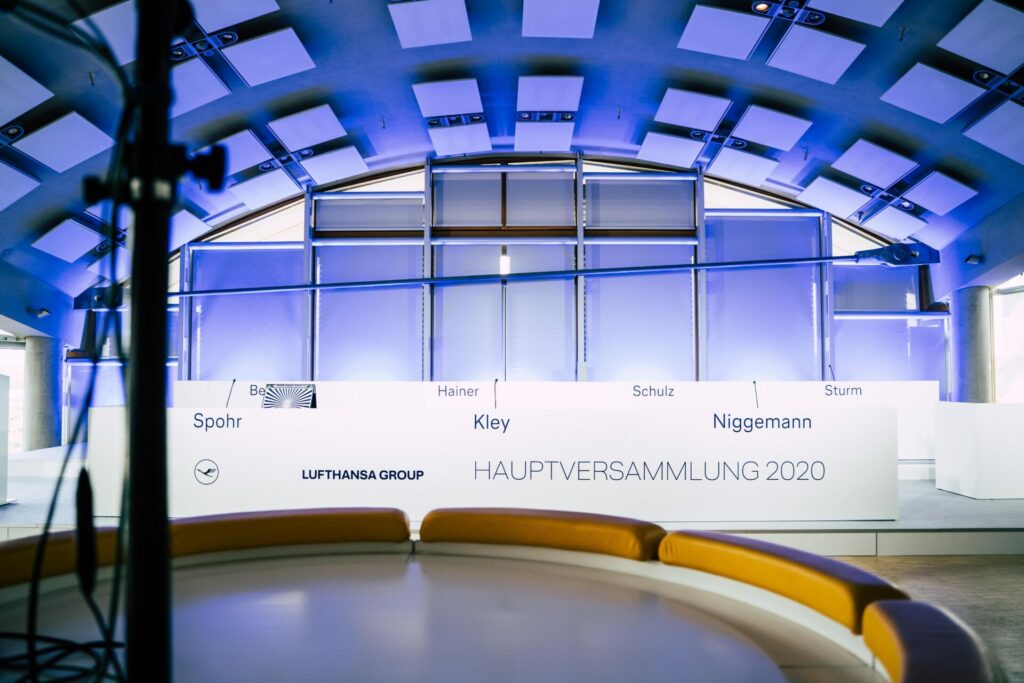
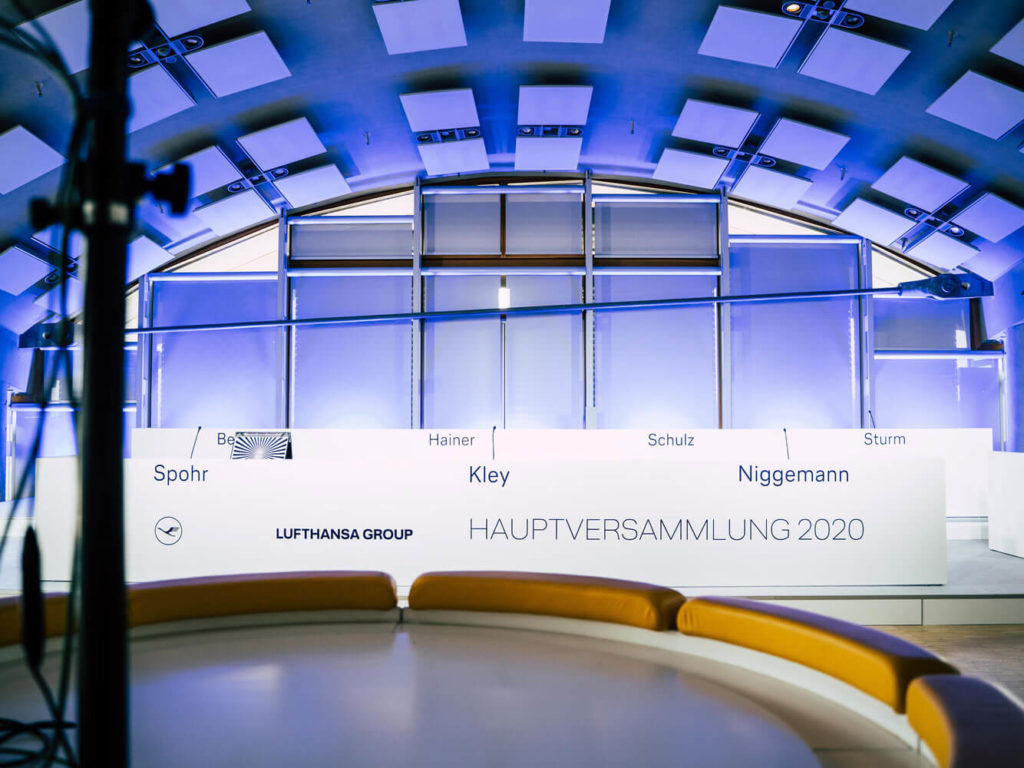
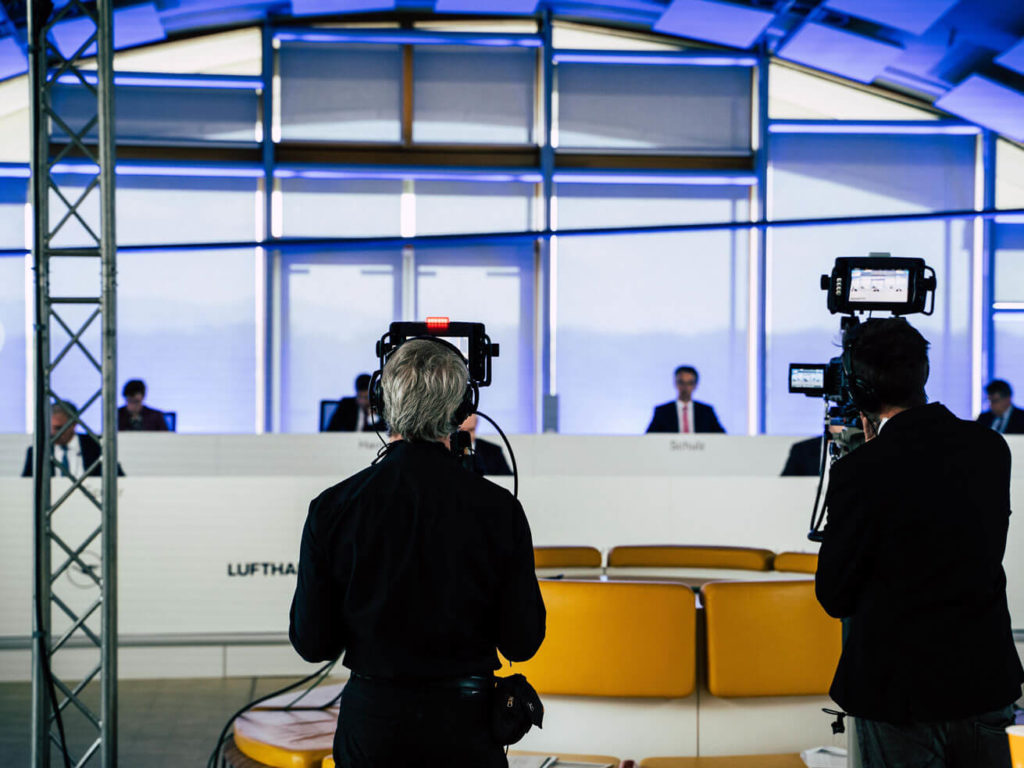
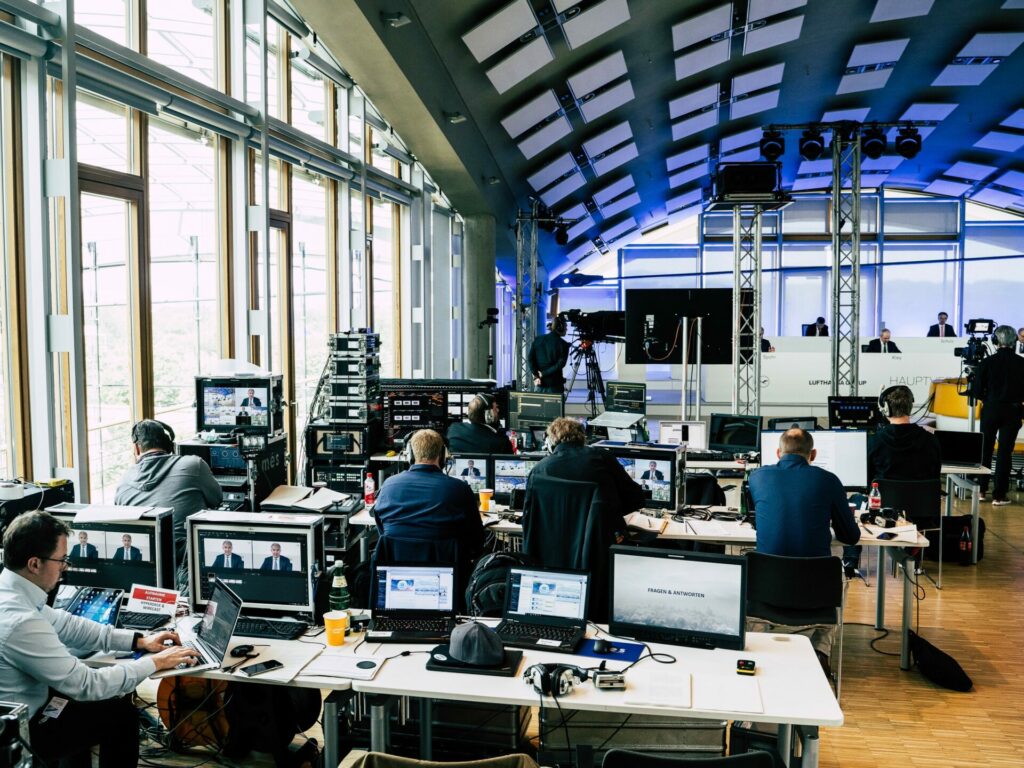
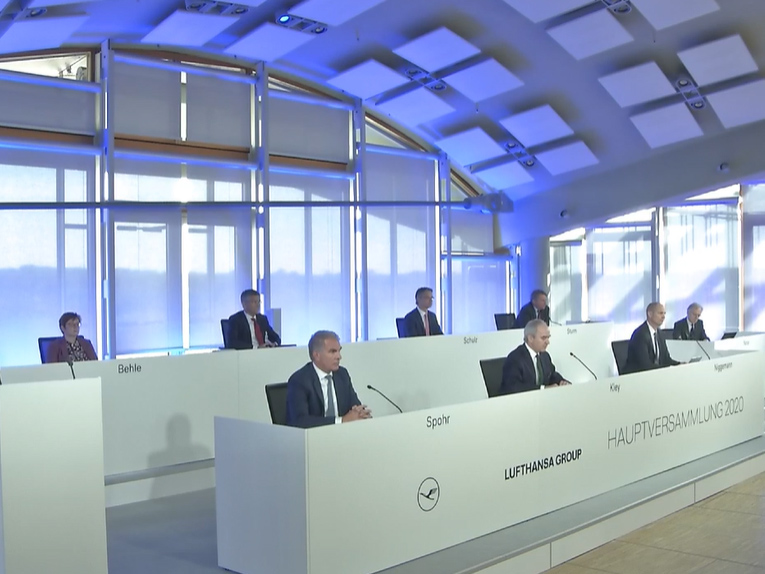
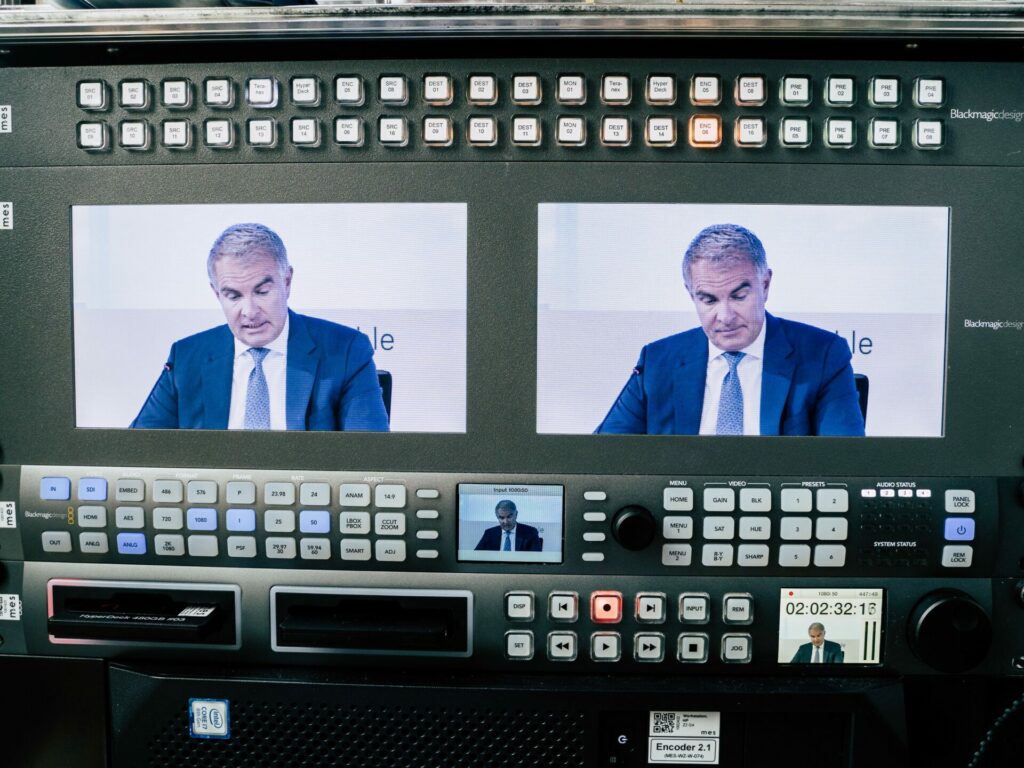
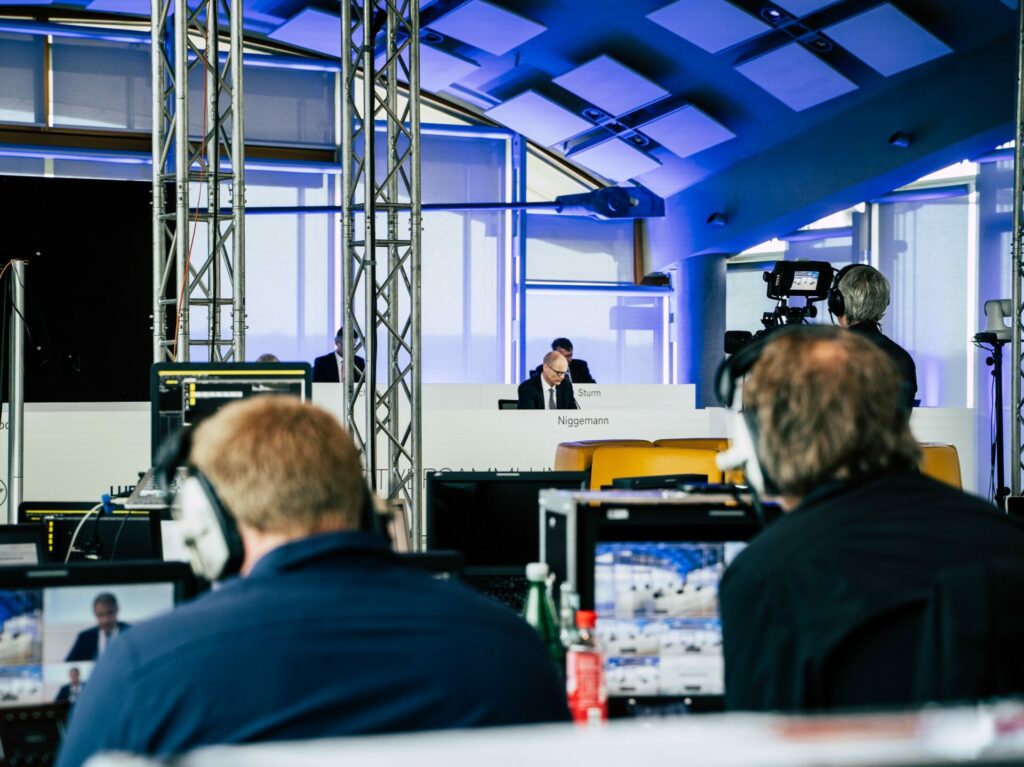
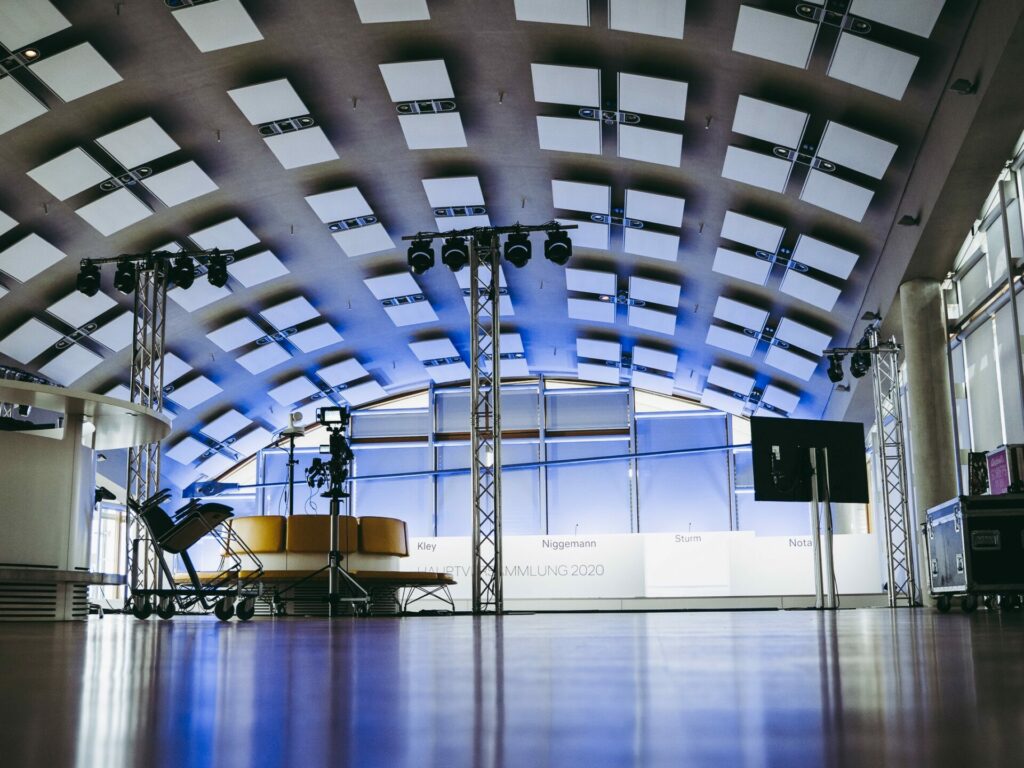
Since 2011, we have been supporting the Lufthansa Group as a production team, along with our SlideSync platform, for the live stream of their Annual General Meeting.
From 2020 onwards, the Annual General Meeting was held exclusively virtually due to the Corona pandemic. Thanks to our long expertise in the field of live streaming online events, we were able to implement the first online annual general meeting of the Lufthansa Group within a very short time.
Check the recording of the Annual General Meeting 2022
With a virtual AGM, your company uses a modern and resource-efficient format for communicating with shareholders and other participants. With ever-changing technological developments and the need for resource-optimized event management, the virtual AGM is only likely to become more and more popular for companies and organizations.
The AGM is rarely the only format in the investor relations calendar. The same production and the same platform also carry the IR call for quarterly results and the annual results press conference — with the difference that no registrar integration is needed there. As a live streaming provider for corporate events, MediaEvent Services has broadcast regulated formats for more than two decades; the AGM is the one among them with the tightest deadlines and the least tolerance for error.
Frequently asked questions about broadcasting an AGM
Who broadcasts an AGM — and who runs the vote?
Those are two service providers. MediaEvent Services broadcasts the meeting in audio and video and integrates the broadcast with the AGM portal. Voting and vote counting sit with the share registrar, as do the notice of meeting and accreditation. Both sides have to coordinate, because access to the protected part of the stream depends on accreditation.
How does electronic voting work at a virtual AGM?
Through the share registrar’s portal, not through the broadcast. Section 118a (1) AktG requires voting rights to be exercised by electronic communication and names electronic participation, postal vote and proxy for that purpose. MediaEvent Services provides the broadcast and the access control; the registrar counts the votes. For cooperatives, section 43b GenG governs the equivalent, and it additionally provides for a staggered procedure with separate discussion and voting phases.
What technology does a virtual AGM need?
Four building blocks at minimum: cameras and audio for the management and supervisory boards, vision mixing, redundant transmission paths to the platform, and a platform that restricts access to accredited shareholders. Video communication for speeches and questions is added to that, because section 118a AktG requires the right to speak by video. How large the production becomes depends on the format: an in-person meeting in a hall needs more cameras and considerably more work on audio than a meeting from a studio.
Can the board report be public while the discussion stays closed?
Yes. Section 118a AktG requires the broadcast to shareholders; a parallel public broadcast is unaffected by this and may be limited in time. In practice that means two outputs from one production: the management board report public, the discussion with shareholders only for accredited access.
Can you broadcast an in-person AGM as well?
Yes, and in 2026 that is the more common case: 21 of the 38 DAX companies held their AGM in person again. It is still broadcast — for shareholders who do not travel, and for the financial press. For the production, what mainly changes is the location: the hall instead of the studio, with an audience in the room.
Is your annual general meeting coming up — virtual, hybrid or in person? Get in touch and we will work out the format, the registrar integration and the scope of the production together.
Let’s talk about your event!