On-site livestream production
On-site livestream production means: the camera crew, audio, lighting, vision mixing and redundant transmission technology come to your location — and stream your internal event live to employees across every site and at home.
At a glance (as of August 2026): The production team and the equipment come to you, and the broadcast runs on a closed platform. Typical internal formats are the employee meeting, the town hall, the works meeting and the leadership meeting. A professionally produced internal town hall costs between €4,000 and €30,000 per event, depending on scope; for preparation we recommend four weeks of lead time.
What happens on site
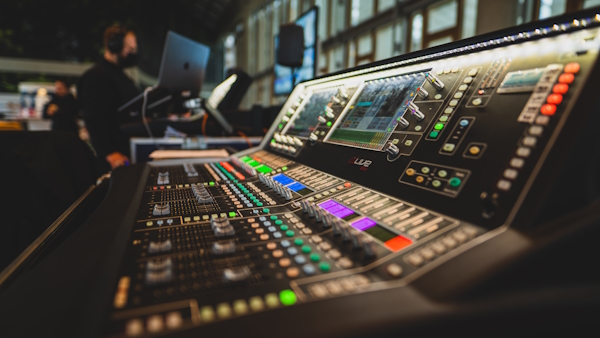
We produce with 4K cameras and broadcast equipment, professional audio and lighting. Where needed, an SNG vehicle carries the signal by satellite into our control room.
Transmission is redundant as a matter of course — two separate paths, a backup encoder, a second operator. If the on-site line is not enough, we bring a Peplink-based 5G bonding router: several cellular channels, any existing DSL line and, where needed, Starlink are bonded into a single connection and reassembled in the data centre. Unlike plain failover, the bandwidth adds up instead of merely switching over. During an internal town hall the entire workforce is watching at once, and a dropped stream is visible to everyone in the same second. Production therefore includes a technical check the day before, a full rehearsal with the speakers, and a written escalation plan.
Our production team travels from Wetzlar. What that means for the region is set out on two separate pages: live streaming provider in Hesse and live streaming provider Frankfurt.
If your event runs without an on-site audience, remote production is the better fit. If you want to broadcast regularly without an external crew, we plan and build a studio on your premises.
Internal formats we produce on site
Internal formats differ from public events in three ways: the audience is closed, the content is confidential, and a failure is noticed by the entire workforce at the same moment.
- Employee meeting and works meeting — company-wide, often involving the works council and several locations
- Town hall and all-hands — the executive board in dialogue with the workforce, with moderated Q&A
- Leadership meeting and management offsite — small audience, high confidentiality, frequently multilingual
- Internal training and inward product launches — with a recording for the media library
- Hybrid formats — an on-site audience with remote participants treated as equals
External formats — the annual general meeting, the IR call, the press conference — carry different requirements; the on-site production is the same.
We support the planning and realization of your corporate event .
What matters with internal livestreams
Four requirements decide whether an internal broadcast holds up. They belong in every first conversation — including the ones where you end up choosing a different provider:
- Access control. Single sign-on via SAML 2.0, so only authenticated employees can watch — connecting to Microsoft Entra ID, ADFS, Okta, OneLogin or Google Workspace. Token-based access or a closed, invitation-only audience are available as alternatives.
- Network load. When several thousand employees at one site watch simultaneously, the bottleneck is not the stream but the site’s internet connection. An Enterprise Content Delivery Network distributes the signal inside the corporate network — in our case via peer-to-peer eCDN with Hive Streaming.
- Interaction. Without a return channel a town hall becomes a speech. Moderated Q&A with an approval workflow, live polls and anonymous questions keep the workforce in the conversation.
- Accessibility and languages. The presentation is part of it: slides arrive as real text beside the video instead of as pixels inside the picture. Live captions, live translation and the AI interpreter reach sites in other language regions; see also accessible livestreams.
On site, remote, or your own studio?
| Criterion | On-site production | Remote production | Your own studio |
|---|---|---|---|
| Audience on site | Yes | No | No |
| Crew at your location | Yes | No | Optional |
| Typical occasion | Town hall with a stage, works meeting, annual general meeting | Management call, IR call, webinar | Recurring formats, e.g. monthly updates |
| Lead time | 4 weeks recommended | 1–2 weeks | One-time build, then days |
| Cost model | Per event, €4,000–30,000 | Per event, considerably lower | Investment, then low per-event cost |
Agency or production provider — which do you need?
The two terms are used interchangeably, but they describe different work. An event agency takes on concept, dramaturgy, staging and guest management. A production and platform provider owns the technical delivery: vision and audio mixing, streaming, access control and interaction.
MediaEvent Services is the second of those and works with the client’s event agency on a regular basis. For purely internal formats the concept usually comes out of internal communications anyway — a technical partner is then enough.
About MediaEvent Services
MES was founded in 1999 and produced its first livestreams of large-scale events in 2000. Since 2006 we have developed and operated our own webcast platform — today SlideSync, running on AWS with data processed in the EU (AWS case study). An ISMS in line with ISO 27001 is in place.
MES has been an AWS partner since 2010: first as a Solution Provider, and at the time one of the first ten German companies in the AWS directory; since 2016 as a Consulting Partner in the AWS Partner Network — and is a member of the Microsoft AI Cloud Partner Program. SlideSync is a certified integration partner of Hive Streaming (directory). SlideSync’s development was funded under Digital Jetzt, a programme of the German Federal Ministry for Economic Affairs and Climate Action; the Bescheinigungsstelle Forschungszulage (BSFZ), Germany’s certification body for the research allowance, has certified MES’s research and development activity (BSFZ seal 2026).
The same platform carries events for regulated institutions and listed companies alike: BaFin and the Deutsche Bundesbank — whose media library on bundesbank.de also runs on it — alongside E.ON, Deutsche Bahn, thyssenkrupp, ZF Friedrichshafen, MAHLE, STADA, CWS, the freenet Group, SWISS, Swissport and AirPlus.
Frequently asked questions about on-site livestream production
What does an on-site livestream production cost?
A professionally produced internal town hall with an on-site team, redundant transmission and the platform costs between €4,000 and €30,000 per event, depending on scope. The drivers are audience size, number of cameras, languages and the resilience requirements. For recurring formats, annual agreements reduce the per-event price substantially.
How much lead time does an internal livestream production need?
We recommend four weeks of lead time — enough for platform branding, a test stream, a full rehearsal and an escalation plan, including with several speakers and languages. Simple setups can be done at shorter notice; for crisis communication we deliver in under 48 hours.
What happens if our corporate network cannot carry the audience?
Then an Enterprise Content Delivery Network is used. The video signal is delivered to the site once and redistributed inside the corporate network, instead of being fetched from the internet separately for every viewer. We use peer-to-peer eCDN with Hive Streaming for this. Whether it is needed is established beforehand from your sites, the expected audience and the available bandwidth.
How do you stop outsiders from watching an internal stream?
Through access control on the platform. SlideSync supports single sign-on via SAML 2.0 and therefore connects to any SAML 2.0-compliant identity provider — Microsoft Entra ID, ADFS, Okta, OneLogin or Google Workspace, for example. Only authenticated employees get access. Token-based access and an audience restricted to invited individuals are available as an alternative or in addition.
Do we need an agency or a production provider?
It depends on what is missing. An event agency takes on concept, dramaturgy and guest management; a production and platform provider owns vision and audio mixing, streaming, access control and interaction. MediaEvent Services covers the second of those and works with the client’s event agency on a regular basis. For internal formats the concept usually comes out of internal communications, so the technical partner is enough.
Can employees at international sites watch in their own language?
Yes. The options are live captions, subtitles in several languages, parallel audio tracks with simultaneous interpreters, and AI-assisted live translation. Which one fits depends on confidentiality, budget and the accuracy required — for board statements in regulated contexts, the human interpreter remains the safe choice.
Try SlideSync!
Let’s talk about your event!