Hybrid Events
Hybrid events combine on-site and online attendance on an equal footing — the in-person audience and remote participants experience the same content, interact with one another, and are treated as technical equals.

Event managers are facing new challenges: after a majority of events were converted to virtual-only formats, requests for on-site events are on the rise again. It is therefore essential to engage with the concept of hybrid events.
A successful hybrid event involves both on-site and remote attendees on an equal level
At a glance
- What is a hybrid event? An event where on-site and online attendees experience the same programme content on an equal footing.
- Typical formats: annual general meeting, town hall meeting, investor relations call, product launch, corporate conference.
- What does it cost? A corporate hybrid event with 50–500 on-site and several thousand remote attendees typically runs in the five-figure euro range per day — excluding venue.
- Which platform? For GDPR-compliant corporate events we recommend our own webcast platform SlideSync — combined with dedicated live production. Other vendors’ platforms can also be a fit depending on the use case; see our platform comparison.
- As of: June 2026.
From hybrid conferences to general meetings
Faced with an infection situation that is still difficult to foresee and significantly more flexible working models, formats are now required that open up on-site events to remote attendees as well, and do so as equally as possible — hybrid events make exactly that possible.
MediaEvent Services has many years of experience in planning and delivering hybrid events. Whether a management call, a hybrid conference or an annual general meeting — we support a wide range of formats for renowned companies and can advise you vendor-independently so that you, too, deliver hybrid events successfully.
An Annual General Meeting is a legally regulated, board-level event, followed live by shareholders and the financial press — a setting where transmission reliability carries direct legal and reputational weight. Companies including the Lufthansa Group have trusted MES with theirs: MES has produced the Lufthansa Group’s AGM live stream since 2011 and delivered the Group’s first fully virtual AGM in 2020. For virtual and hybrid shareholder meetings, MES integrates with share registrars including Computershare and ADEUS. Founded in 1999, the MES team produces hundreds of live events a year, regularly for audiences in the tens of thousands.
We support the planning and realization of your corporate event .
Hybrid Events with SlideSync
With SlideSync’s webcast platform, you can engage participants on-site and online equally:
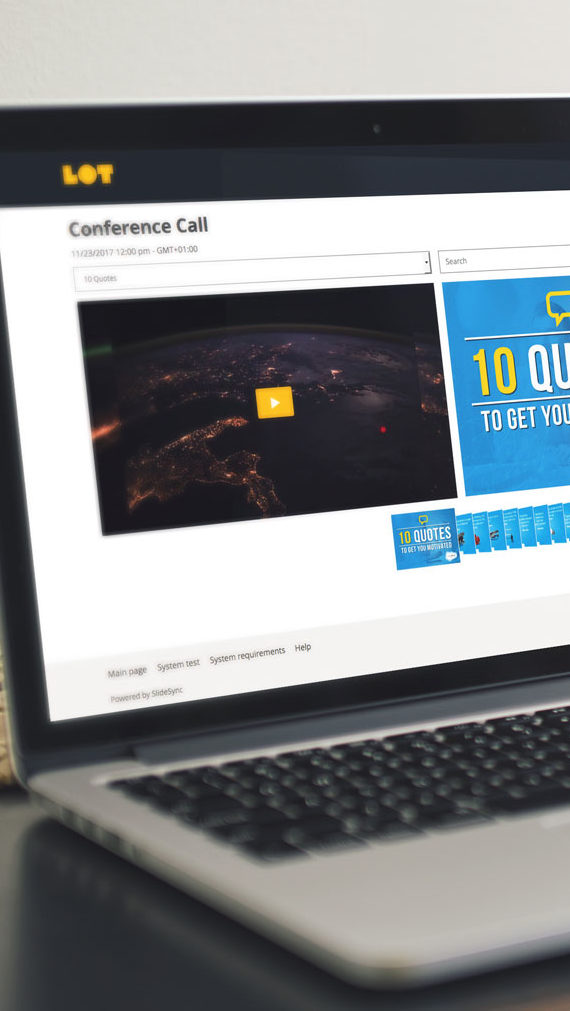
Moderated question and answer sessions (Q&A)
Engage in a structured dialogue with your audience!
Public questions with voting
Quickly and transparently reveal the topics that matter most to your audience.
Surveys
Gather opinions and make sure your content has been understood.
Attendee management & visitor portal
Self-registration with attendee details, a confirmation email, an attendee list restricted to invited guests and GDPR-compliant evaluation: the visitor portal for hybrid events keeps track of who attends — and admits only those who are approved.
Hybrid Events Provider: what to look for when choosing one
Not every provider covers both worlds — on-site production and scalable streaming — equally well. When selecting a hybrid-events provider, these criteria are decisive:
- GDPR-compliant EU hosting — attendee and event data exclusively in the EU, with a data processing agreement; mandatory for annual general meetings and IR formats.
- Platform and live production from a single source — avoids interface problems between separate providers.
- Scaling without network load — an eCDN connection (e.g. Hive Streaming) for corporate events with several thousand remote participants.
- Attendee management & visitor portal — self-registration, access control and GDPR-compliant evaluation of attendance.
- Multilingual delivery — live translation by interpreters or by an AI language track, multilingual subtitles and parallel audio streams.
- References in the corporate space — experience with annual general meetings, town halls or product launches is more telling than feature lists.
MediaEvent Services covers these criteria with its own webcast platform SlideSync and dedicated live production — vendor-independent advice included.
High quality at low network load
SlideSync can stream high-definition video content of your hybrid event to thousands of employees and stakeholders without burdening your corporate networks:
Enterprise Content Delivery
Distributes content within the corporate network and relieves the central internet access.
Split Tunneling
Connects home-office users outside the VPN and relieves your VPN/RAS infrastructure.
When is a hybrid event worth it versus purely on-site or purely virtual?
The table below summarises the key differences — in practice, the hybrid format pays off above all when reach beyond the physical capacity matters and, at the same time, in-person presence adds value (e.g. networking, press conference, annual general meeting with shareholder dialogue).
| Criterion | On-site only | Hybrid | Online-only event |
|---|---|---|---|
| Reach | Limited by room capacity | On-site + global digital | Global, location-independent |
| Cost per attendee | High (catering, travel) | Medium (plus streaming tech) | Low |
| Networking quality | High | High on-site, limited online | Limited |
| CO₂ emissions | High (travel) | Reduced | Minimal |
| Technical effort | Classic event technology | Streaming + event tech + sync | Pure streaming platform |
| Data analysis | Manual, limited | GDPR-compliant analytics | Full analytics |
| Flexibility for attendees | Low | High | Very high |
Opportunities and limitations of hybrid events
Hybrid events have permanently changed event culture. On the one hand, contemporary hybrid conferences deliver new experiences for attendees. On the other hand, they also bring various opportunities as well as constraints for you as a host.
What advantages do hybrid events offer?
Hybrid events entail a number of new opportunities and perspectives. In particular, these include:
Interactive participation of attendees
In contrast to classic on-site events, hybrid events let you use interactive online elements. These include, for example, surveys or a chat function for interaction between attendees. With modern technologies such as augmented or virtual reality, you can additionally give on-site attendees the chance to discover hidden bonus content. Interactive participation creates a markedly better experience and binds attendees more strongly to your event and your company.
Greater reach through location-independent attendance
Digital access to events lets attendees join regardless of location and, in some cases, regardless of time. Hybrid events thus also allow people who cannot be on-site for reasons of time, personal circumstances or cost to take part in your event. A Bitkom study shows that 68% of German companies ran at least one hybrid event in 2024 — almost twice as many as in 2021 (source: Bitkom 2024). On top of that, all attendees can rewatch any recordings of the event afterwards.
Reporting and analytics
Thanks to professional digital attendee management, hybrid events enable the collection and evaluation of all attendee data — naturally in compliance with the GDPR. This way you can evaluate not only how many visitors your event had, but also, for example, which content was used most often and what the audience engaged with most. The evaluated data forms a solid basis for developing future events, improving their content and even personalising them for individual target groups.
A high-quality attendee experience
Hybrid events offer the chance to give attendees an even better event experience. They are generally perceived as modern and innovative, and they also offer scope for branding in line with the host’s corporate design. This increases the likelihood that future events will attract higher attendance and that your company can build a long-term relationship with its audience.
Contribution to sustainability
Sustainability is becoming an ever more important factor in organising events. Hybrid events contribute to it by reducing the number of attendees who have to travel to the venue. This not only saves a considerable amount of travel-related CO₂ emissions, it can also significantly reduce on-site waste. Hybrid events therefore contribute substantially to efficiency — especially when it comes to sustainability.
What risks should be factored into hybrid events?
Alongside the many advantages and opportunities hybrid events can offer, possible constraints and risks should also be weighed carefully in advance. These may include, for example:
Higher staffing effort and investment
If an event is also to be filmed and live-streamed, appropriately trained staff are required. The support of online attendees should not be neglected either. At the same time, more extensive technical equipment and a competent webcast provider are needed for hybrid events. This can entail additional effort, which usually pays for itself quickly. We provide trained staff and the necessary technology at fair prices.
Complex processes require training
Hybrid events involve considerably more complex workflows than purely on-site events. All content and information must be adapted so that both groups of attendees can take it in optimally — including accessibility per WCAG 2.2, which from June 2025 becomes mandatory for many providers under the German Accessibility Strengthening Act (BFSG) (source: BMAS, BFSG 2025). Handling these complex workflows also requires training your own staff in advance. We provide professional training and the know-how needed for a successful delivery — see also our page on accessible livestreams.
Possibly fewer live attendees
Hybrid events also offer attendees many advantages. For some, the time saved by avoiding travel can be a reason not to attend on-site. Factor this into your planning and assess the split between the attendee groups early on. With our efficient invitation and registration management, you can organise this with ease.
Frequently asked questions about hybrid events
Is MediaEvent Services a hybrid-event agency?
Not in the classic sense. MES specialises in the technical production and the streaming platform for hybrid events — on-site vision and audio mixing, GDPR-compliant streaming, attendee management and moderated Q&A. Concept, stage design or guest management are often handled by the client’s event agency, with whom we work hand in hand. If you’re looking for a partner specifically for the digital and production side, you’re in the right place — if you need a full-service agency, you combine the two.
What is the difference between a hybrid event and a virtual event with a recording?
A hybrid event takes place on-site and online at the same time — remote participants can ask questions live, take part in polls and interact with the on-site audience. A virtual event with a recording, by contrast, is asynchronous: the online audience consumes the recording later, passively, with no way to interact. Hybrid formats are more demanding to deliver but generate higher engagement.
How many attendees are realistic for a hybrid event?
The on-site component is limited by room capacity — typically 50 to 500 attendees. The remote component scales with the platform used: SlideSync supports several thousand simultaneous online participants per stream. For very large corporate events (e.g. global employee town halls), an eCDN connection is needed so the corporate network is not overloaded — see our page on the Enterprise Content Delivery Network.
What does a professional hybrid event cost?
Costs depend heavily on scope and ambition. A one-day corporate hybrid event with on-site live production, a streaming platform for several thousand remote participants, live subtitling, Q&A moderation and a professional crew typically runs in the five-figure euro range per day — excluding venue rental and catering. We calculate transparently and per project.
How much lead time does a hybrid event need?
For a professional delivery we recommend four weeks of lead time — especially for the technical preparation (platform setup, rehearsal, corporate-network integration, moderator training). At short notice, one to two weeks are feasible if all stakeholders decide quickly — talk to us.
Can a hybrid event be run in a GDPR-compliant way?
Yes — provided the platform stores attendee and event data in the EU and offers the necessary GDPR features (consent management, a data processing agreement, data export and deletion). SlideSync is built for this; see our page on GDPR-compliant live streaming.
How do you make sure remote participants don’t feel excluded?
Three principles are decisive: (1) dedicated moderation for the remote side that brings online questions to the on-site plenum; (2) Q&A and voting tools that are visibly treated the same for both groups; (3) deliberately scheduled breaks with networking options for both sides (e.g. moderated online breakout rooms in parallel with on-site catering). Without these three, the remote audience quickly degrades into a silent spectator.
Which platform is suitable for hybrid events?
The choice depends on requirements such as data-protection level, number of remote participants, interaction needs and your existing software landscape. For GDPR-compliant corporate events we recommend our own platform SlideSync, combined with dedicated live production. For a vendor-independent overview of all relevant platforms, see our livestreaming provider comparison.
Can hybrid events be delivered in multiple languages?
Yes — with live translation (simultaneous interpreting or AI-based), multilingual subtitles and multiple audio streams per language. We regularly deliver multilingual annual general meetings and international corporate events; see our pages on multilingual events and live translation.
Sounds interesting?
Contact us right away to discuss your hybrid event project, or check out our SlideSync platform for yourself!
Try SlideSync!
Let’s talk about your event!